What the LGR Pause Means for Blue Badge Services

LinkedIn Link for Kay Ainsworth
Author:

Kay Ainsworth

Local Government Reorganisation has entered a new period of uncertainty.

Following the Government’s announcement of a review of the LGR programme, decisions in several areas have been withdrawn and plans elsewhere paused while the future approach is considered.

For councils affected, that changes the timetable, but it does not change the need to deliver effective services today.

Blue Badge teams still have applications to process, residents to support, service pressures to manage and opportunities to improve the way they work. The question is no longer simply how councils prepare their Blue Badge services for a known reorganisation date. It is how they continue improving services now while retaining the flexibility to respond to whatever comes next.
The Pause Does Not Mean Services Can Pause

The uncertainty surrounding LGR has already required significant time and attention from local authorities.

But councils cannot put service improvement on hold while the future structure of local government is determined.

Residents will continue to expect accessible, efficient digital services. Teams will continue to face pressure from increasing application volumes, administrative workloads and fragmented processes.

For Blue Badge services, delaying improvements until the future of LGR becomes clear could mean maintaining inefficient processes for another one, two or even three years.

There is another option.

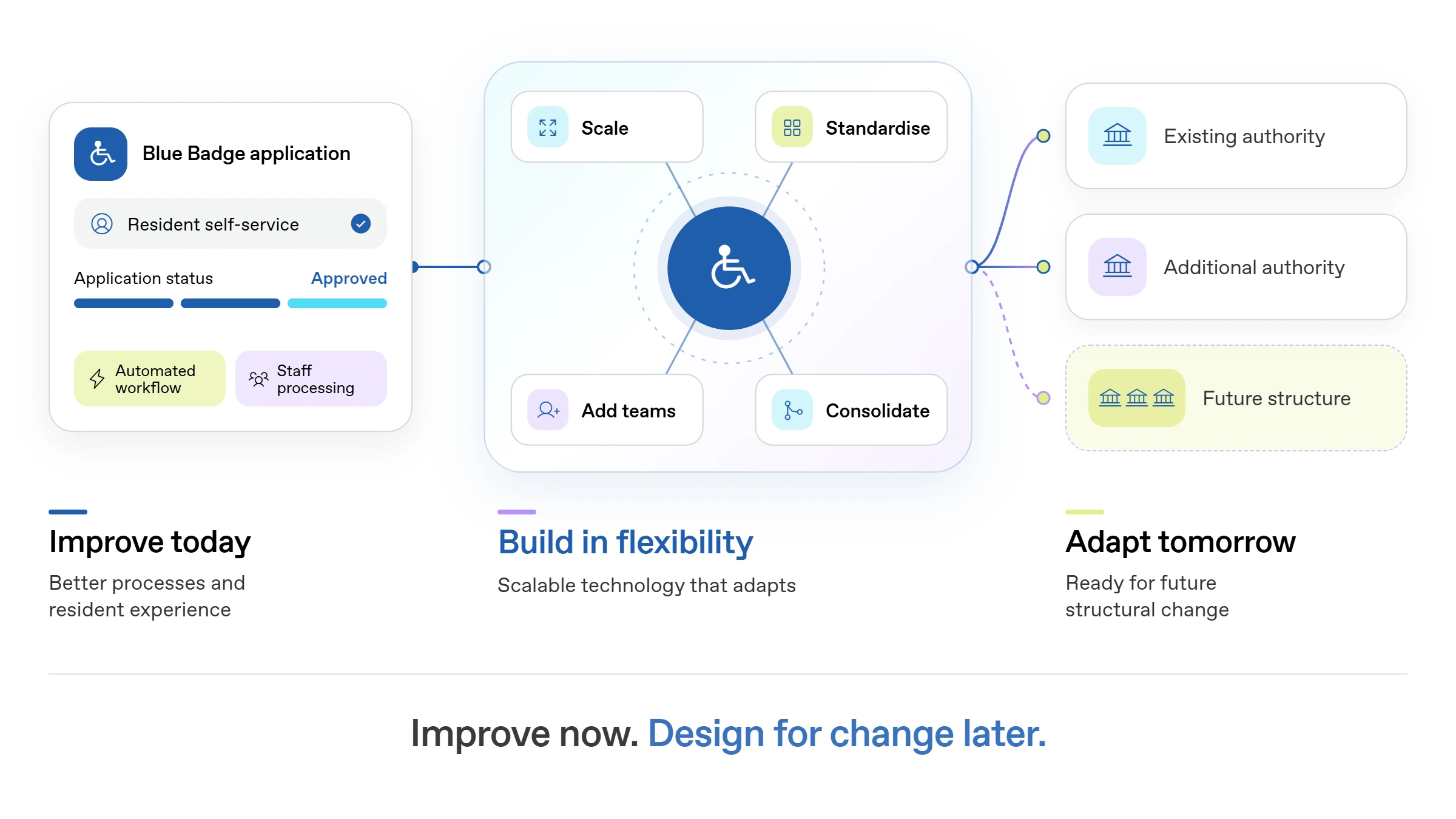
Improve now. Design for change later.


Modernising Without Locking in Today's Structure

Councils should not make technology decisions based on the assumption that their current organisational structure will exist indefinitely.

Equally, uncertainty around future structures should not prevent them from addressing problems that exist today.

The priority should be technology that can improve the current service while providing enough flexibility to respond if organisational boundaries, responsibilities or operating models change.

For Blue Badge teams, that could mean introducing more automation, digital self-service and clearer communication with applicants now, while ensuring the underlying technology can scale across additional councils, users and services in the future.

Bringing Multiple Services Together

If reorganisation does proceed in some form, new authorities may still inherit different systems and processes for managing Blue Badge applications.

Some councils operate highly digital workflows, while others rely more heavily on manual administration or separate systems.

That makes flexibility important regardless of the eventual timetable.

Technology should make it possible to extend successful approaches across additional teams or authorities, rather than requiring councils to start again if organisational structures change.

It should also support the longer-term consolidation of different services and deployments where that becomes appropriate.

Standardising Processes

LGR has highlighted differences in the way services are delivered between neighbouring councils.

For Blue Badge services, these differences can include application routes, evidence requirements, eligibility processes, communication with residents and internal workflows.

Councils do not need to wait for reorganisation to start addressing those inconsistencies.

Standardising and simplifying processes today can deliver immediate benefits for residents and staff while also making any future consolidation significantly easier.

The objective should be to create better services now that can adapt to a different organisational structure later.

Planning for Flexibility

The current uncertainty makes flexibility increasingly important when councils assess technology and service improvement.

Blue Badge teams should consider:

  • whether existing systems can respond to changing application volumes and organisational structures
  • whether services can be expanded to additional teams or authorities without significant redevelopment
  • how easily processes and eligibility approaches can be standardised
  • whether technology can support multiple councils before potentially consolidating into a future authority
  • how Blue Badge services could connect with concessionary travel and wider citizen-facing services
  • whether commercial arrangements provide appropriate flexibility if council structures change

These are useful questions whether LGR proceeds on the previous timetable, takes a different form or is delayed further.

Keep Improving the Resident Experience

Perhaps the most important point is that the experience of residents should not depend on the timetable for structural reform.

People will continue to apply for Blue Badges. They will continue to expect clear information about their applications and timely decisions. Council teams will continue to need tools that reduce unnecessary administration and help them manage demand.

The Government may be reviewing what the future structure of local government should look like, but councils still need to deliver services in the meantime.

IEG4’s Blue Badge solution provides a scalable, end-to-end digital service designed to help authorities standardise processes, automate routine tasks and create a more consistent experience for residents and staff.

Crucially, councils can improve those services today without assuming that today’s organisational boundaries will remain unchanged.

The opportunity is not to wait for certainty.

It is to improve now and design for change later.