The NHS cannot deliver preventative care with reactive data

LinkedIn Link for Rob De Felice
Author:

Rob De Felice

As NHS reform places greater responsibility on Integrated Care Boards, the case for joined-up data in All Age Continuing Care has never been stronger, says Rob De Felice, Business Development Director at IEG Group.

The NHS is entering a period of significant structural change. The Government’s plans to abolish NHS England entirely have now been firmly set in motion, with the view to give Integrated Care Boards (ICBs) greater responsibility as strategic commissioners. This is intended to create clearer accountability, reduce duplication and support more locally focused decision-making.

However, structural reform alone will not make care more integrated or preventative. To achieve that, healthcare leaders need access to better information about the people and pathways they are responsible for.

This is particularly important in All Age Continuing Care (AACC), where demand is increasing, cases are becoming more complex and teams are operating under considerable financial and workforce pressure.
Continuing care is still too reactive

Across Continuing Healthcare, Funded Nursing Care, Children and Young People’s continuing care and other complex pathways, services often respond only once a person’s needs have escalated.

Assessments may begin after a deterioration has already occurred. Placement breakdowns are addressed when they become a crisis. Capacity is forecast using historic activity, rather than emerging patterns of need. By that point, the available options are often more limited and more expensive.

The Healthcare Financial Management Association’s recent report, claims that CHC needs ‘urgent attention’ as social care overspends by £715m. This underlines the scale of the challenge facing continuing healthcare and the wider care system. The report’s findings reinforce that AACC cannot be viewed solely as an administrative process. It is also a significant financial and operational issue for health and care systems.

Yet many teams still lack a joined-up view of the full journey. Information can be spread across referral forms, spreadsheets, emails, local databases and separate systems used by different organisations. This makes it difficult to identify common patterns, understand where delays are emerging or see when a person may be at risk of needing more intensive support.

It is clear that the NHS does not necessarily have a shortage of data. It has a shortage of connected, usable intelligence due to the quality of the data held.

ICB reform raises the stakes

The Government’s proposed reforms will place ICBs at the centre of local strategic commissioning, while also increasing the emphasis on financial responsibility and performance.

That creates an important opportunity to rethink how AACC is managed. ICBs should not have to rely on retrospective reports to understand demand, identify bottlenecks or assess the impact of commissioning decisions. They need information that supports action while there is still time to make a difference.

This will require more than digitising individual forms. The whole AACC journey, from referral to assessment, decision, placement and review, needs to be connected through a reliable digital foundation.

That means a single record for each case, workflows that reflect the complexity of different pathways and clear visibility of who is responsible for the next action. It also means creating an audit trail that demonstrates how decisions were reached, rather than relying on disconnected evidence assembled after the event.

AI should create capacity for care

Artificial intelligence has an important role to play in continuing healthcare, but the starting point should be the needs of practitioners and the people they support.

For example, AI transcription can reduce the time spent writing up multidisciplinary discussions and assessments. Automated population of the Decision Support Tool can reduce repetitive data entry and help create more consistent records.

These applications do not replace professional judgement. They support it by removing some of the administrative burden that prevents clinicians and care professionals from focusing on complex decisions, conversations with families and person-centred planning.

However, AI is only as useful as the information it is working with. If records are inconsistent, incomplete or disconnected, automation may simply make an inefficient process faster without making it better.

The first step towards intelligent care is therefore structured information. Information that can be searched, compared and used confidently across the system.

From reporting what happened to anticipating what comes next

Once AACC information is captured consistently across a population, the possibility of predictive insight becomes much more realistic.

The aim is not to automate decisions about an individual’s care. It is to identify patterns that may indicate rising risk, deterioration, escalation or placement breakdown. If those signals can be detected weeks or months earlier, professionals may have more opportunity to intervene before a situation becomes a crisis.

That could mean reviewing a package of care, engaging with a provider, bringing professionals together sooner or identifying additional support for a person and their family.

Earlier intervention may improve outcomes and experience, while also reducing avoidable escalation and the costs associated with crisis responses. At a time when the NHS is being asked to deliver efficiencies, this is a more meaningful definition of productivity than simply expecting stretched teams to process more work.

Building a more proactive model

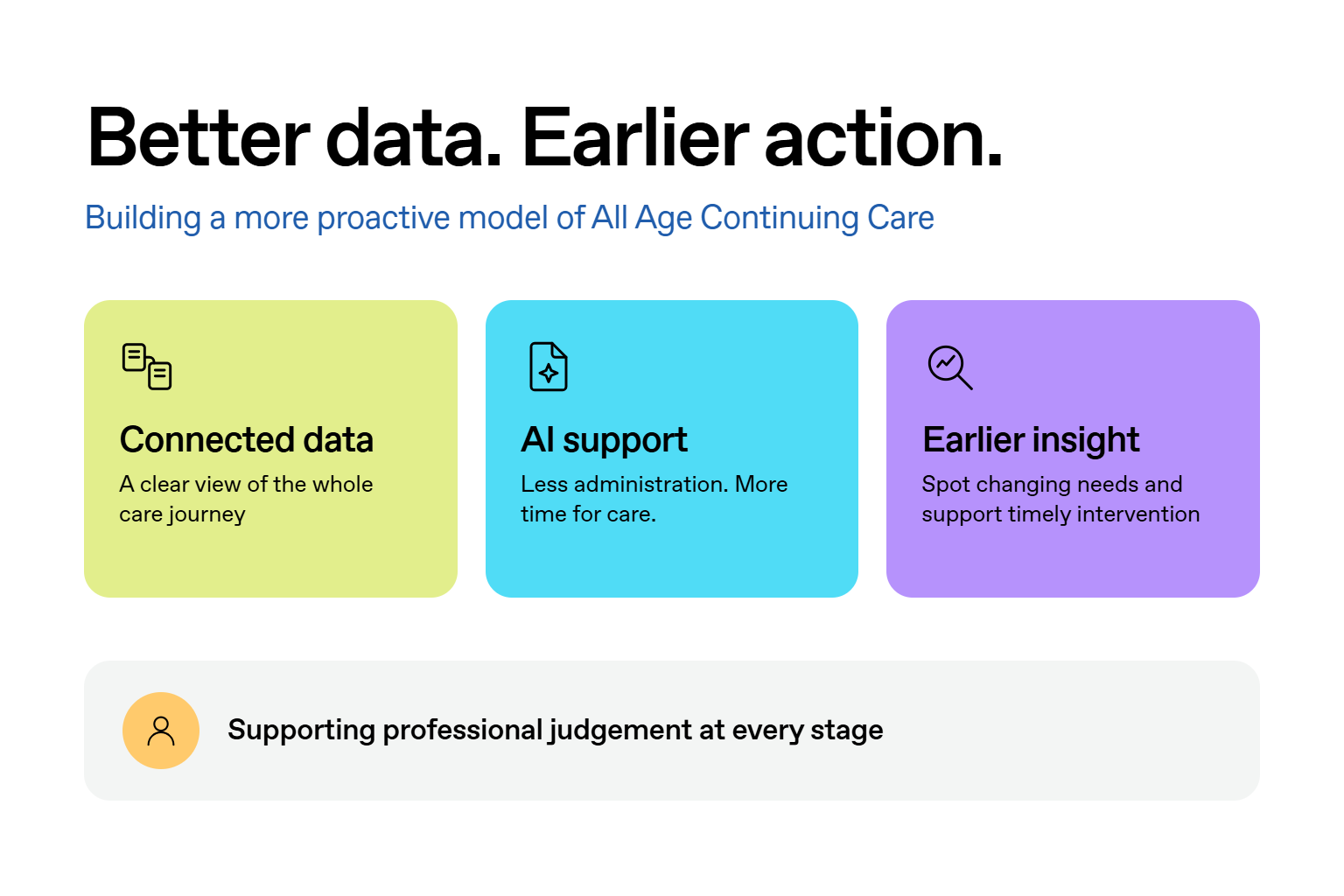
The future of AACC will depend on three capabilities working together. The first is a digital foundation that captures the full journey. The second is an AI layer that supports practitioners and reduces unnecessary administration. The third is a predictive layer that turns structured records into insight about emerging need.

This is the direction of travel that ICBs should be considering as they prepare for a more integrated and financially accountable health system.

Reform will not succeed if new structures inherit the same fragmented information and reactive processes. To make prevention possible, leaders need to know not only what has happened, but what is beginning to happen and where intervention could change the outcome.

The opportunity is to create AACC services that are more visible, more evidenced and better equipped to act before need escalates. That will require responsible use of technology, strong governance and continued collaboration between health and care professionals.

Most importantly, it can provide cost savings for the ICBs which is increasingly crucial in the current climate.